Respecting First Nations knowledge on Wikimedia platforms
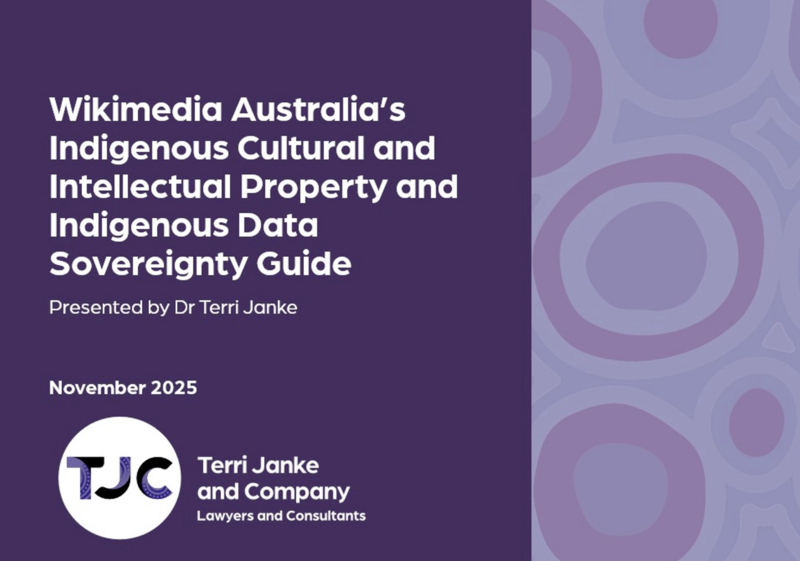
Indigenous Cultural and Intellectual Property (ICIP) and Indigenous Data Sovereignty Guide
What if writing a better Wikipedia article meant asking a different question first? “Who has the cultural authority to tell this story?”
Today we are honoured to release two significant publications, developed through a partnership with Terri Janke and Company, and in consultation with the Wikimedia Australia community. Dr Terri Janke and her team have created the Wikimedia Australia Indigenous Cultural and Intellectual Property (ICIP) and Indigenous Data Sovereignty Guide, and alongside it, the white paper CultureStrong Platforms: Setting the Standard at Wikimedia.
Developed through an Indigenous-led process, these publications provide practical guidance for Wikimedia contributors, while asking important questions and opening an international conversation about respecting Indigenous knowledge, cultural authority and self-determination within one of the world's largest open knowledge movements.
Next week this work moves onto the global stage at Wikimania 2026 in Paris, Wikimedia's annual international conference. The publications will be shared with delegates from around the world, while Dr Janke will facilitate the First Nations keynote panel in the Equity stream, leading international discussions on the future of Indigenous knowledge on the Wikimedia platforms.
These contributions mark an important moment not only for Wikimedia Australia, but for the wider Wikimedia movement.
The publications were developed by Terri Janke and Company, an award-winning, 100% Indigenous-owned law firm internationally recognised for its leadership in ICIP and IDSov. We are deeply grateful to Dr Janke, Shevaun Wright, Matilda Langford, the First Nations Expert Group of Leonard Hill, Dr Jessica Russ-Smith, Dr Kirsten Thorpe, Dr Tamika Worrell, Yanti Ropeyarn and Miriam Corowa, and the entire team for their leadership, expertise and generosity throughout this project. We also extend a heartfelt thank you to everyone who contributed their knowledge, perspectives and lived experiences along the way, especially those who participated in a consultative workshop at WikiCon Canberra earlier this year.
A different way of understanding knowledge
The CultureStrong White Paper opens with a simple but powerful analogy:
Across Australia and the Pacific, shells have long held cultural significance. Traded across vast distances, worked into adornment, ceremony, tools and art. A shell found on a beach can look like it belongs to no one, free for anyone to pick up and take away. Yet it carries a deeper story. It comes from a living ecosystem, with connections to place, to sea Country, and to the people who understand its meaning.
Indigenous knowledge is often treated the same way. Once it's written down, archived, digitised or placed online, it's assumed to be free for anyone to use. And in Western law, the person who writes it down or records it becomes the copyright owner. But knowledge doesn't lose its connection to the people, communities and Countries it comes from simply because it is documented or becomes publicly accessible. Like the shell, it carries relationships, responsibilities and cultural meaning that deserve respect.
That idea sits at the heart of this work, which is called CultureStrong. At its centre is a simple but powerful question:
Who has the cultural authority to tell this story?
(Excerpt from CultureStrong Platforms, Terri Janke and Company).
Why we need a Guide for Indigenous Content
Wikipedia, Wikimedia Commons and Wikidata are built on openness. Anyone can read them, anyone can contribute, and almost everything is shared under open licences. However, this ‘openness’ has been designed around the Western concepts of individual authorship, neutrality, verifiability and unrestricted reuse. This version of openness frequently contrasts with Indigenous knowledge systems, that are often communal, specifically contextual and relational to Country and community, include oral information sharing practices, and include cultural responsibilities that are not sufficiently recognised by a Western legal framework. As a result, content added or uploaded to Wikimedia platforms relating to Indigenous peoples and cultures, often reproduces misinformation and harm. Without guidance, users and Wiki editors are at risk of disclosing Secret/Sacred knowledge, spreading misinformation, misrepresenting cultural practices, removing knowledge from the proper contexts, undermining the rights of Indigenous people to protect their cultural heritage, and can even contribute to the loss or erosion of cultural practices. However, with guidance, Wikimedia contributors can better understand ways in which they can respectfully and accurately engage with Indigenous peoples, knowledges and cultures.
Previous research commissioned by Wikimedia Australia including the First Nations focus group report “I really like Wikipedia but I don’t trust it”, identified concerns about harmful metadata, deficit-based language, limited Indigenous agency and the absence of clear cultural protocols. It also highlighted how historically inaccurate information about First Nations peoples and cultures recorded in Western sources can continue to be reproduced online, perpetuating incorrect information, misrepresenting Indigenous histories and knowledge systems and conflicting with Indigenous knowledges.
The Guide has been specifically developed as a practical resource to help address these challenges.
Putting the Guide into practice
Wikimedia Australia has adopted the Guide as organisational practice for our Board, staff and funded projects. We are also pleased to share it as recommended good practice for editors and contributors who want to engage responsibly with Indigenous content across Wikimedia projects. It's grounded in a set of clear values:
- Valuing relationships and accuracy over quantity
- Respecting Indigenous cultural authority and protocols
- Being transparent about what is shared on Wiki platforms
- Supporting Indigenous agency and authorship
- Avoiding harm
Rather than prescribing rules, the Guide outlines a risk-assessment approach, helping contributors to think through whether the content in front of them is lower-risk (general, non-sensitive Indigenous content) or something that calls for a higher level of caution (culturally sensitive, secret or sacred, or offensive material), and steps to follow in each case. It provides guidance on reliable sources and citation, metadata and description. It also addresses free, prior and informed consent (FPIC) – the principle that communities have the right to make decisions about their own knowledge before it's used. Shevaun Wright, Senior Associate from Terri Janke and Company describes this clearly stating “It’s not about content moderation, but about content integrity”.
This isn't a departure from open knowledge. It is an evolution of it
Working this way strengthens what the Wikimedia Movement already stands for. The mission rests on knowledge that is accurate, verifiable and accessible, and on platforms that are genuinely inclusive. Knowledge that centres cultural authority leads to better sourcing, fewer errors repeated as fact, and a richer, more trusted record, one in which Indigenous peoples can recognise and place themselves, their histories and their voices.
Communities around the world are already demonstrating what this looks like. In Western Australia, Noongarpedia created a Noongar-language platform supporting language revitalisation through Indigenous-led participation. In Canada, the Atikamekw Nation partnered with Wikimedia Canada to translate articles, images and audio into their language. In Aotearoa New Zealand, Māori contributors have opened vital conversations about protecting mātauranga Māori as taonga. And the Mukurtu and Local Contexts initiatives developed with the Warumungu community in the Northern Territory, created tools using Traditional Knowledge Labels that let Indigenous communities communicate cultural protocols online.
The White Paper: the questions we're still sitting with
The Guide gives practical direction. The CultureStrong White Paper is honest about what's unresolved. It examines where open licensing and customary law pull against each other, where the law is silent, and where the wider Wikimedia movement, not just in Australia but worldwide, needs to keep talking.
It also looks ahead. It recommends developing a dedicated First Nations Protocol for Wikimedia Australia through a staged, Indigenous-led process shaped with communities, Knowledge Holders and Wikimedians. Such a Protocol would deliver what the editing community is asking for: scenario-based guidance that reflects the diversity of the 200-plus First Nations across the Australian continent, and offering a methodology other Wikimedia chapters could adapt internationally.
This matters just as much for the hundreds of millions of people who read Wikimedia projects as it does for those who edit them. For many, Wikipedia is the first place they go to learn about Aboriginal and Torres Strait Islander peoples, cultures and histories. Increasingly Wikimedia content is also used by artificial intelligence (AI) systems, including as part of the training data and knowledge sources that underpin many Large Language Models (LLMs). When the knowledge behind those pages is accurate, well-sourced and shared with cultural authority, readers can trust what they find – fewer errors repeated as fact, less colonial framing carried forward, and a record in which First Nations peoples can recognise themselves. Equally important, a comprehensive First Nations Protocol would clearly demonstrate WMAU’s commitment to respectful engagement, ethical practice, prioritising cultural safety and genuine inclusion for Indigenous peoples and communities. Getting this right will make Wikipedia and other Wiki projects more trustworthy for everyone who relies on them.
To get there, the White Paper poses ten consultation questions – on cultural safety, secret and sacred content, metadata and naming, dispute resolution, reliable sources, participation and leadership, training, language revitalisation, and shared standards. Both WMAU and Terri Janke & Company warmly invite you to contribute your ideas and perspectives through an online survey.
What you can do – join the conversation
If you edit, run edit-a-thons, or work with GLAM collections that hold First Nations material, we'd love you to read the Guide and put it to work. Being genuinely engaged with CultureStrong means going beyond "including" First Nations content. It means centering self-determination, respect for cultural authority, and building strong connections through partnerships. Additionally, we welcome your suggestions, case studies and comments on the White Paper. Both WMAU and Terri Janke and Company will take on board this feedback to inform the next phase of our project, in implementing the ICIP & IDSov Guide. This will involve creating practical tools and supports for editors, as well as addressing the remaining challenges in Indigenous knowledge on Wiki projects.
This is an exciting first step in collaborating to develop respectful guidance for WMAU and Wikimedians, and we know there is more to do as this work is long, collective and ongoing. WMAU is honoured to be celebrating the sharing of the ICIP & IDSov Guide that is practical and self-determined, and the CultureStrong Platforms white paper to prepare for future stages, through our incredible partnership with Terri Janke and Company. We invite you to use this valuable resource, consider the consultation questions and join the ongoing conversations to help shape the next phase of this important work.
Together, we can build Wikimedia projects that are not only open, but also culturally respectful, more accurate and stronger because of the knowledge they share.
Accompanying resources
- Download the White Paper - CultureStrong: Setting the standard at Wikimedia
- Download the Wikimedia Australia Indigenous Cultural and Intellectual Property (ICIP) and Indigenous Data Sovereignty Guide
- Share your feedback on the consultation questions (listed below):
- Carlson, B., & Rana, L. (2024). “I really like Wikipedia, but I don’t trust it” Understanding First Nations peoples' experiences using Wikipedia as a reader and/or editors.
Stay up to date
- Stay up to date with what WMAU is doing in the space: Wikimedia-au-icip mailing list (you'll need a free postorious account, or contact us to be added to the mailing list).
Consultation Questions
Send your responses to the Consultation Questions to the WMAU team via the consultation form.
Recognition and Respect of ICIP and IDSov
- How can Wikimedia platforms better recognise and respect Indigenous Cultural and Intellectual Property (ICIP), Indigenous Data Sovereignty (IDSov) and Indigenous cultural authority within existing platform policies and governance structures?
Cultural Safety
- What changes to platform policies and practices would make Wikimedia a culturally safe environment for Indigenous peoples globally, including protection from harmful, disrespectful or hostile treatment of Indigenous people and Indigenous Content?
Secret, Sacred and Sensitive Content
- How should Wikimedia platforms handle Secret/Sacred or otherwise culturally sensitive Indigenous Content, particularly where open-access principles conflict with Indigenous protocols about who may hold, access or share that knowledge?
Metadata, Naming and Categorisation
- How can Wikimedia improve existing metadata, categorisation and naming systems to better reflect Indigenous perspectives, languages, Nations, Countries and cultural governance systems?
Decision-making and Dispute Resolution
- What authority should Indigenous peoples and communities hold in decisions about Indigenous Content, including how it is moderated and how disputes are resolved?
Reliable Sources and Indigenous Knowledge
- How can Wikimedia’s ‘Reliable Sources’ frameworks be expanded to properly recognise Indigenous-led sources, oral histories, community-controlled knowledge and Indigenous language materials?
Participation and Leadership
- What practical steps could Wikimedia take to grow Indigenous participation and leadership amongst contributors, editors, administrators and Wikimedia governance bodies internationally?
Training and Cultural Competency
- What training, educational resources and cultural competency initiatives are needed to better support contributors working with Indigenous Content across Wikimedia platforms?
Language Revitalisation and Indigenous-led Projects
- How can Wikimedia platforms actively support Indigenous language revitalisation, Indigenous-led digital knowledge projects and culturally appropriate ways of sharing knowledge online?
Collaboration and Shared Standards
- How can the global Wikimedia movement work in partnership with Indigenous peoples to co-design culturally responsive protocols, governance frameworks and best-practise standards for open knowledge?
Send your responses to the Consultation Questions to the WMAU team via the consultation form.