
Who and what Wikipedia leaves out: findings from wikihistories

On 11 November, Wikimedia Australia hosted the final seminar of the wikihistories project, How Wikipedia represents Australia. Researchers from the University of Technology Sydney (UTS) and the University of Melbourne shared what they found after three years of studying how English Wikipedia covers Australian people, places and historic events.
Professor Heather Ford led the session, with Dr Michael Falk, Dr Francesca Sidoti and podcast producer Jane Curtis. Wikimedia Australia President Elliott Bledsoe gave a response, and the session finished with questions from the audience.
The project was funded by the Australian Research Council. Heather described it as probably the most detailed study yet of how Wikipedia represents a single country.
- View the recording of the November 11 seminar on Wikimedia Commons
- View the recording of the November 11 seminar on YouTube
Australian people
The team found around 83,000 biographies of Australians on English Wikipedia, using Wikidata queries and the "Australian people" category tree. The categories turned out to be messy. Steve Wozniak counted as Australian because he once held an honorary role at UTS, and some compilation albums by the band Custard ended up in the data as people.
Some of the findings:
- Gender – There are far more biographies of men than women, and the gap is not closing. But more than half of the biographies of men are stubs, while biographies of women and of trans, non-binary and intersex people are more often rated C-class or above.
- Order of Australia – Women usually get a Wikipedia article only after they receive an Order of Australia. Men are more likely to have one already. Women recognised for work in caring professions are the most likely to get an article late or not at all.
- Indigenous Australians – The share of biographies of Indigenous people roughly matches the census. The issues the team found were in how Indigenous people are described and categorised, not in the number of articles.
- History – There is a bias towards recent people, but the early colonial period is heavily overrepresented compared to the population at the time.
Michael also introduced wikkitidy, an R package the team built to make it easier to get data out of Wikipedia for analysis.
Australian places
The team looked at more than 35,000 articles about Australian places, studied the Australia, Tasmania and Katoomba articles in detail, and interviewed 14 editors. Francesca explained that coverage is centred on cities and towns founded by settlers. Only about 6% of place articles include a First Nations dual name. The Katoomba article, at the time of research, left out the 1957 forced removal of Aboriginal people from Garguree, known as "the Gully". After the team's report came out, editors found sources and added it.
The editors the team spoke to had very different approaches, and there was no simple link between who they were and what ended up in articles. Several described stepping back from contentious topics because the arguments wore them down. Francesca suggested that bringing in new editors matters, but on its own it won't fix the problem without also looking at how policies and categories work.
Australian events
Heather presented new work with Dr Ivan Smirnov on what Australians read on Wikipedia. Articles about people are the most read, followed by entertainment. Events make up about 9% of reading, and disasters only a small part of that – until a disaster happens.
During the 2019–20 Black Summer bushfires, the bushfire article was the main source of traffic from Australia to the climate change article. That traffic came through a link in the article's infobox, which editors have argued over. Bushfire articles also rely heavily on Australian editors. The team's paper on this is currently under review.
The podcast

Jane Curtis talked about making All That We Touch: Wikipedia, a six-part narrative podcast from UTS Impact Studios. The first three episodes look at what shapes Wikipedia. The last three are about reading it well, with a quiz, advice for teachers and librarians, and a live panel recorded at WikiCon with Dr Terri Janke. The show notes include transcripts, references and tip sheets for teachers.
What the team recommends
Heather closed with suggestions for researchers, editors and Wikimedia Australia:
- Researchers – do more local, national and comparative studies, and repeat them over time.
- Editors – consider local rules or standards for Australian topics, such as notability of Australians, articles about places with dual names, and how bushfire articles link to climate change. Agreeing on these could mean fewer arguments on individual articles.
- Wikimedia Australia – keep supporting local norms, and help readers understand how Wikipedia is made.
The team's next project, Question Machines, will look at the open data that generative AI chatbots rely on when answering questions about Australia.
Wikimedia Australia's response
Elliott Bledsoe said Wikipedia and its sister platforms “may be the last best place on the internet, but that doesn’t exempt them from scrutiny and a push to do better". He said research like this is input, not an attack, and it feeds into Wikimedia Australia's planning. He also pointed out that bias on Wikipedia is carried into AI systems trained on its content.
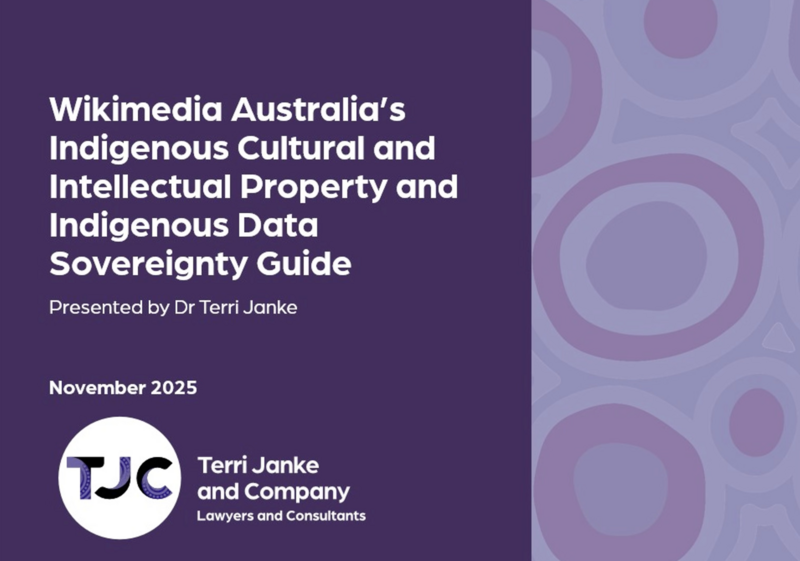
Elliott invited editors to engage in the conversation on-wiki for a CultureStrong project. It will bring together editors applying the ICIP Guide developed with Terri Janke and Company. You can read more in Putting the ICIP Guide into practice on Wikimedia projects.
Questions from the audience
Attendees asked how the team handled Australian content inside global articles, and whether anyone had compared Australia with Canada or New Zealand. Michael said their method could only count articles that are about Australian people or places, so wider Australian content is harder to measure. No one has yet done a comparison with similar countries. An Adelaide editor also talked about deletion debates where overseas editors don't see local topics as notable. Heather said this is where local editors working together, and local rules, could help.
Thank you to Heather, Michael, Francesca, Jane and the wikihistories team, and to everyone who joined us and asked questions.
Further resources
- wikihistories project
- wikihistories reports
- All That We Touch: Wikipedia podcast
- A Manifesto for Wikimedia Research
- Question Machines
- View the seminar recording on Wikimedia Commons
- View the seminar recording on YouTube
Earlier wikihistories events
- How Wikipedia represents Australia: findings from Wikihistories — Wednesday 11 November 2026
Which Australian people, places and historic events does Wikipedia tend to represent? What is missing and what explains Wikipedia’s biases? What does it mean to edit Wikipedia about Australian topics today? - Wikihistories 2024: Wikipedia and/as Data — Wednesday 19 June 2024
What is Wikipedia’s relationship to data? What should Wikipedia’s relationship to data be? - Wikihistories 2023: Wikipedia and its implications for memory (and forgetting) — Wednesday 7 June 2023
An two-day online conference on Wikipedia as a history-making platform
This work was supported by the Australian Research Council, https://ror.org/05mmh0f86. [Discovery Grant, ID DP220100662].